
Loop
Overview
Iterates through each item in an array, executing a set of stages for every element in the collection.
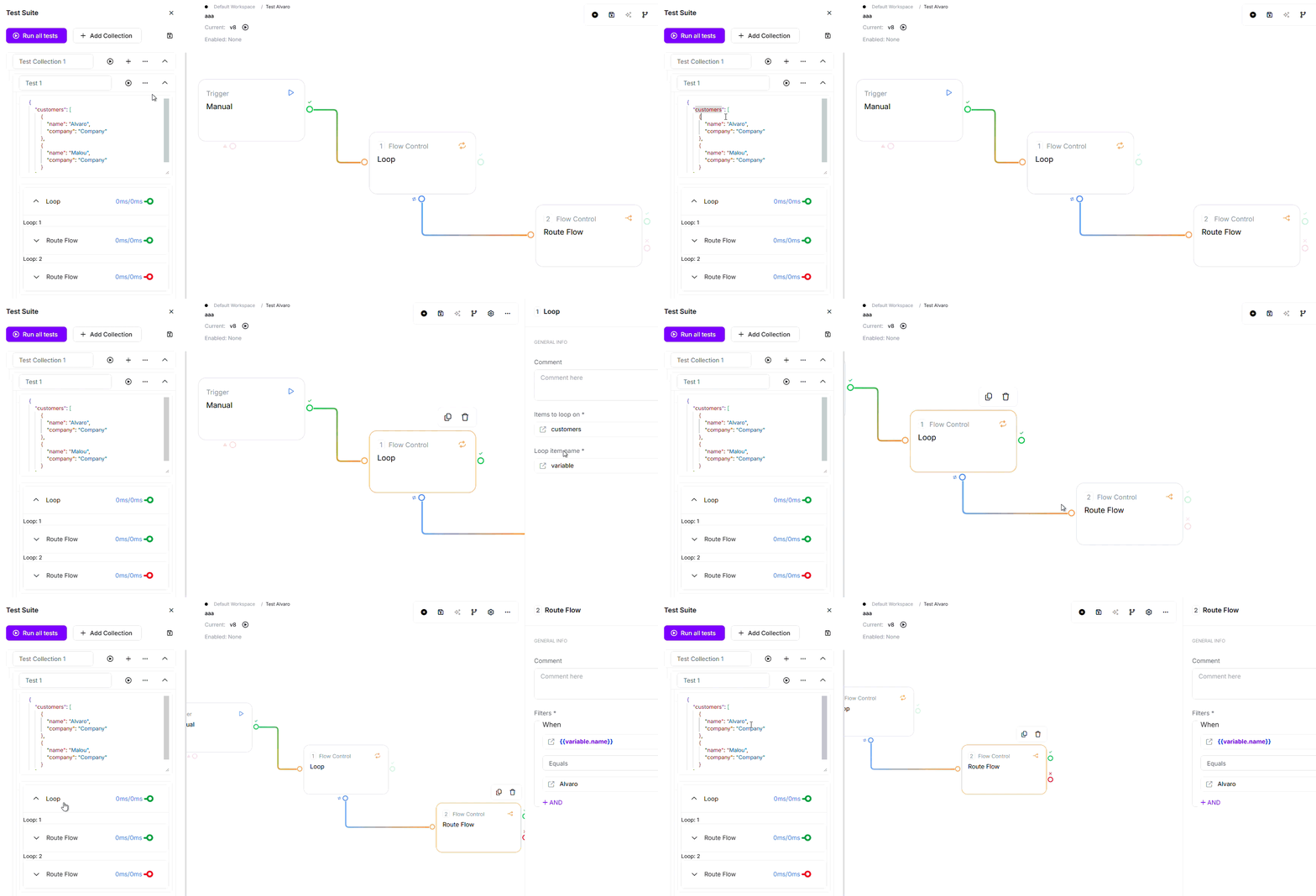
IMPORTANT: The fields do not contain {{}} just plain text as it is an Array. When specifying the Items to Loop On field, use the plain variable name (e.g., customers) rather than the variable reference syntax (e.g., {{customers}}).
When to Use
- Process each item in a list of records
- Send emails to multiple recipients
- Update multiple database records
- Transform array data item by item
- Perform calculations on each element
- Make API calls for each item in a collection
- Generate reports for multiple entities
Configuration
Fields Reference
| Field | Type | Required | Description | Example |
|---|---|---|---|---|
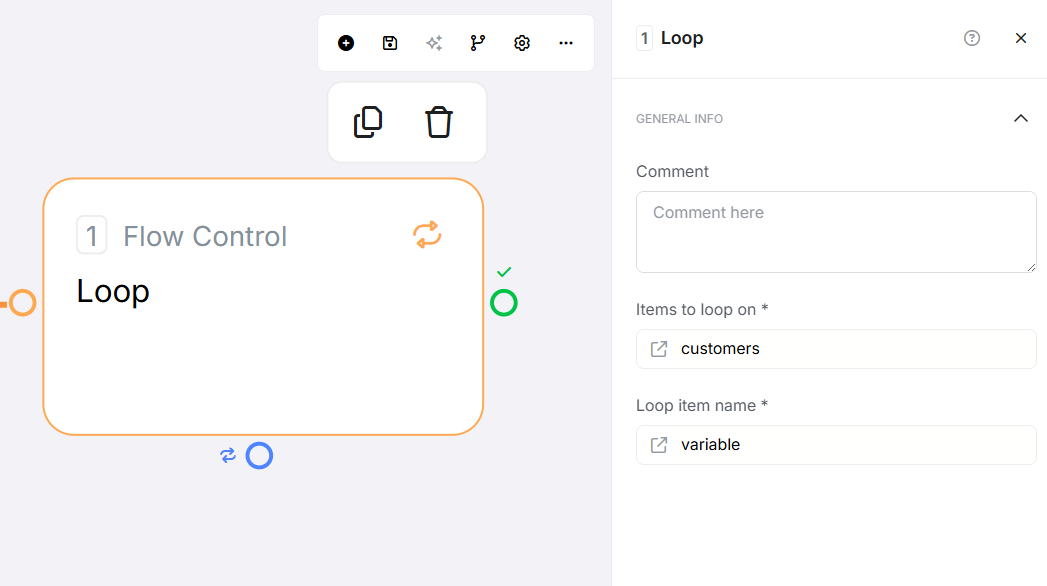
| Items to Loop On | Array | Yes | Array variable containing items to iterate (use plain variable name, not {{}} syntax) | customers, orderItems, emailList |
| Loop Item Name | String | Yes | Variable name for the current item during each iteration (default: variable) | customer, order, item |
Critical Note: When configuring Items to Loop On, enter the plain variable name without {{}} brackets. The system treats this as an array reference.
Exit Points
| Exit | When | Purpose |
|---|---|---|
| Iterate | Executes for each item in the array | ✓ Connect stages that run once per array element |
| Pass | After all items have been processed | ✓ Flow continues after loop completes |
How It Works
When executed, the stage:
- Parses the Array - Converts items into a processable collection
- Iterates Sequentially - Processes items one at a time (not parallel)
- Sets Current Item - Makes item available via Loop Item Name variable
- Executes Iterate Path - Runs connected stages for current item
- Waits for Completion - Finishes iteration before moving to next item
- Repeats - Continues until all items processed
- Exits via Pass - After all iterations complete
Item Access Patterns
| Item Type | How to Access | Example |
|---|---|---|
| Primitive (string, number) | Use {{variable}} directly | {{variable}} if item is a simple ID |
| JSON Object | Use dot notation for fields | {{variable.userid}}, {{variable.email}} |
| Nested Object | Chain dot notation | {{variable.address.userid}} |
Common Use Cases
1. Send Email to Multiple Recipients
- Items to Loop On: customers
- Loop Item Name: customer
- Iterate Path: Call API to send email with {{variable.email}} and {{variable.userid}}
2. Calculate Totals
- Items to Loop On: cartItems
- Loop Item Name: item
- Iterate Path: Increment Number with {{variable.price}}
- Pass Path: Fetch Data to get final total
Key Behaviors
| Feature | Behavior |
|---|---|
| Processing Order | Sequential (one at a time, not parallel) |
| Empty Array | Goes directly to Pass exit (no iterations) |
| Variable Cleanup | Previous item variable removed before loading next item |
| Debug Limit | Debug output shows first 15 iterations only |
| Loop Counter | ✗ No counter variable exposed to flow |
| Break Early | ✓ Use Stop Loop stage to exit before completion |
| Nested Loops | ✓ Supported (use unique loop item names) |
Do's and Don'ts
| Do | Don't |
|---|---|
✓ Use descriptive loop item names (customer better than item) | ✗ Use generic variable names (makes code unclear) |
| ✓ Connect the Iterate exit to stages that run per item | ✗ Try to loop non-array data (ensure input is array) |
| ✓ Connect the Pass exit to continue after loop | ✗ Create infinite loops (ensure iterate path completes) |
| ✓ Keep iterations simple to avoid timeouts | ✗ Access wrong variable (use customer, not customers) |
| ✓ Handle errors within iterations using error exits | ✗ Modify the source array during iteration |
| ✓ Use Stop Loop to break out early when needed | ✗ Forget to connect exits (both required) |
| ✓ Test with small arrays first before large datasets | ✗ Assume arrays always have items (handle empty case) |
| ✓ Use unique names for nested loops | ✗ Use same variable name in nested loops (causes conflicts) |
Troubleshooting
| Issue | Common Cause | Fix |
|---|---|---|
| Loop doesn't execute, goes straight to Pass | Iterate exit not connected | Always connect Iterate exit to stages you want to run for each item |
| Flow stops after loop completes | Pass exit not connected | Connect Pass exit to continue flow after all iterations complete |
| Variables from loop items not accessible | Using wrong variable name | Use loop item name customer, not array name customers within iterations |
| Loop processes wrong data | Passing single object instead of array | Ensure loop input is actually an array/list; verify source variable contains array |
| Loop never completes | Iterate path doesn't return to loop | Ensure iterate path eventually completes and returns control for next item |
| Cannot access nested object fields | Not using dot notation | Access nested fields with dot notation: {{customer.address.userid}} |
| Nested loops overwrite variables | Variable name conflicts between loops | Use unique, clear names for each loop level ({{customer.name}} and {{variable.name}}) |
| Stage errors not handled in loop | No error exits on iterate stages | Add error exits on stages within iterate path to handle failures gracefully |
| Loop parsing fails (Error exit) | Invalid JSON in array variable | Verify array variable contains valid JSON array format; check source data |
| Debug output stops after 15 items | Debug mode iteration limit | Normal behavior; loop continues processing all items, just stops logging after 15th |
Edge Cases
Empty Array
Loop body never executes. Goes directly to Pass exit. This is normal behavior, not an error. Ensure Pass exit is connected to handle zero-iteration scenario.
Single Item Array
Iterates exactly once, then exits via Pass. No special handling required.
Null Items in Array
If array contains null items, they're stored as null in dictionary. Loop doesn't skip nulls automatically. Downstream stages must handle null values.
Breaking Out Early
Use Stop Loop stage to exit before all items processed. After break, goes to Pass exit (not a different exit).
Very Large Arrays (10,000+ items)
No explicit limit enforced. Performance scales linearly with array size. Consider flow timeout settings. Debug output capped at 15 iterations to avoid performance issues.
Nested Arrays
If array item is itself an array, nest another Loop stage inside to iterate nested arrays. Parent loop provides context for child loop.
Related Stages
- Stop Loop: Exit a loop early when a condition is met
- Route Flow: Make decisions within each iteration
- Change Data: Transform data during each iteration
- Save Data: Store results from each iteration
- Call API: Make API calls for each item